
This document describes the features and characteristics of the BLF1820-90 UHF power LDMOS transistor, including output power, gain, efficiency, suppression, etc. It is suitable for GSM, EDGE, CDMA base stations, and multicarrier applications.
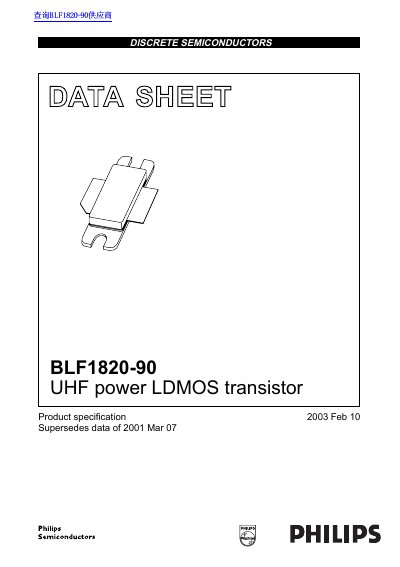
This document is a product specification datasheet for the BLF1820-90, a 90 W LDMOS power transistor intended for RF power amplifiers in GSM, EDGE, and CDMA base stations. The device operates in the 1800 to 2000 MHz frequency range and features typical output power of 90 W (PEP) with a gain of 12 dB at a supply voltage of 26 V.
| Output Power | 90 W (PEP) |
|---|---|
| Gain | 12 dB |
| Efficiency | 32% |
| Operating Frequency Range | 1800 to 2000 MHz |
| Drain-Source Voltage | 65 V |
| Gate-Source Voltage | +15 V |
| DC Drain Current | 12 A |
| Junction Temperature | 200 °C |
The transistor is designed for broadband operation from 1800 to 2000 MHz.
At a supply voltage of 26 V and Ipq of 500 mA, the output power is 90 W (PEP) with a gain of 12 dB.
The maximum junction temperature (Tj) is 200 °C.