
This document introduces a method for reducing HPLC solvent use and waste. By changing the HPLC column while keeping the same bonded phase, it is possible to realize a 40 to 90 percent reduction in acetonitrile usage. Possibilities include reducing the diameter of the column, changing to a shorter column with a smaller particle size, or a simultaneous reduction of length, diameter, and particle size. These options are easy to implement, do not require redevelopment of the method, and in some cases significantly reduce the analysis time.
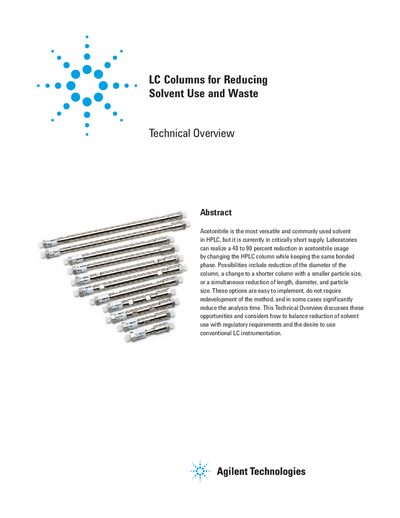
This document addresses the global shortage of acetonitrile in HPLC laboratories and presents strategies to reduce solvent usage by 40 to 90 percent. It focuses on changing column dimensions, specifically reducing the column diameter from 4.6 mm to 3.0 mm or 2.1 mm, and adjusting particle size or length. These changes allow for significant solvent savings without requiring complete method redevelopment in many cases.
| Solvent reduction range | 40 to 90 percent |
|---|---|
| Standard column ID | 4.6 mm |
| Solvent Saver column ID | 3.0 mm |
| Narrow bore column ID | 2.1 mm |
| Solvent savings for 3.0 mm ID | 60 percent |
| Solvent savings for 2.1 mm ID | 80 percent |
Laboratories can realize a 40 to 90 percent reduction in acetonitrile usage by changing the HPLC column while keeping the same bonded phase.
Changing column diameter, length, or particle size is typically easier to implement because it does not change the chemistry or require redevelopment of the method.
The USP and FDA allow a reduction of column length by 70 percent, for example from a 250 mm column down to a 75 mm column.