
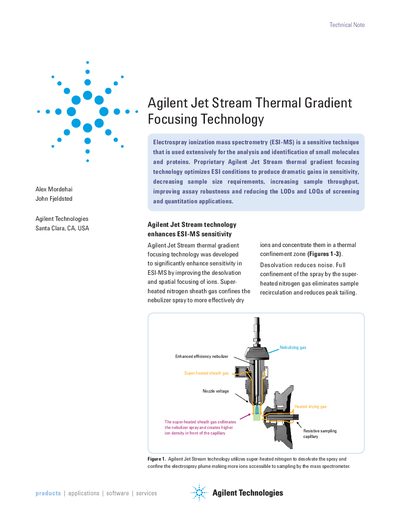
Agilent Jet Stream technology enhances sensitivity in ESI-MS by improving the desolvation and spatial focusing of ions. Super-heated nitrogen sheath gas effectively dries ions and concentrates them in a thermal confinement zone. Desolvation reduces noise. Full confinement of the spray by the super-heated nitrogen gas eliminates sample recirculation and reduces peak tailing.
Agilent Jet Stream thermal gradient focusing technology is a proprietary method designed to optimize electrospray ionization (ESI) conditions for mass spectrometry. By utilizing super-heated nitrogen sheath gas, the technology creates a thermal confinement zone that effectively desolvates the spray and concentrates ions. This process significantly improves desolvation efficiency and spatial focusing of ions compared to conventional methods.
The document highlights that this technology produces dramatic gains in sensitivity, allowing for smaller sample sizes and increased throughput. It reduces limits of detection (LODs) and limits of quantitation (LOQs) while improving assay robustness. The text provides data showing signal intensity improvements of 5 to 10-fold across various flow rates and applications, including trace pesticide analysis, drug analysis in biological matrices, and illicit drug detection in urine.
| Recommended Sheath Gas Temperature | 350° C |
|---|---|
| Recommended Sheath Gas Flow | 11 mL/min |
| Recommended Nozzle Voltage | 600 V |
| Recommended Nebulizer Pressure | 30 psi |
| Recommended Chamber Voltage | 4k |
It optimizes ESI conditions to produce dramatic gains in sensitivity by improving desolvation and spatial focusing of ions.
The recommended operating parameter for the sheath gas temperature is 350° C.
The recommended operating parameter for the sheath gas flow is 11 mL/min.
The recommended operating parameter for the nozzle voltage is 600 V.