
The Agilent 2100 Bioanalyzer is used in protein analysis, which can measure protein fluorescence intensity by microfluidic capillary gel electrophoresis to determine protein molecular weight and concentration
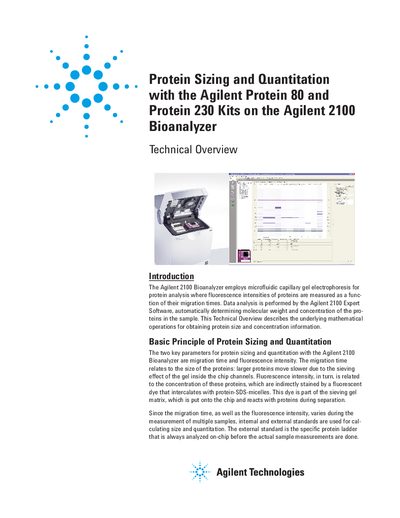
This document provides a technical overview of protein sizing and quantitation using the Agilent Protein 80 and Protein 230 Kits on the Agilent 2100 Bioanalyzer. It details how the system employs microfluidic capillary gel electrophoresis to measure fluorescence intensities as a function of migration times.
Protein size determination is calculated via a standard curve from the ladder, which converts measured migration times of unknown proteins to their sizes.
Relative concentration is calculated by comparing peak areas against an internal upper marker added in a defined ratio to each sample.
Data analysis is performed by the Agilent 2100 Expert Software, which automatically determines molecular weight and concentration.