
The 7500ce ICP-MS from Agilent Technologies is designed for the analysis of environmental, clinical, and other high matrix samples, providing the best detection limits for trace elements in challenging sample types such as wastewater, seawater, soils, foods, and biological samples. It features a user-friendly Octopole Reaction System (ORS) for interference removal in high matrix samples, redesigned ion optics, and a high transmission reaction cell, resulting in a 5x sensitivity increase compared to its predecessor. The 7500ce also incorporates Agilent's Active Flow Control system for plasma and cell gas control, and a new digital-drive RF generator for high coupling efficiency. It is configured to meet strict environmental regulatory requirements, including those set by the US EPA.
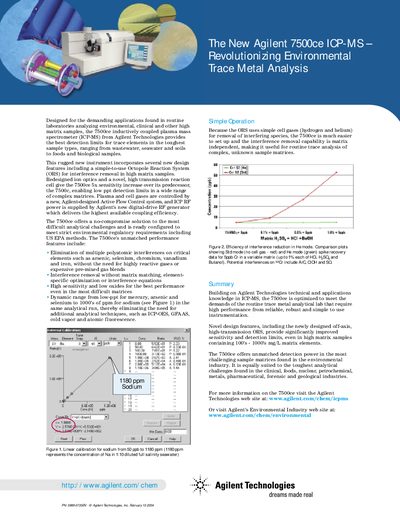
The Agilent 7500ce inductively coupled plasma mass spectrometer (ICP-MS) is designed for demanding applications in routine laboratories analyzing complex high-matrix samples such as wastewater, seawater, soils, foods, and biological materials. It incorporates a simple-to-use Octopole Reaction System (ORS) to eliminate multiple polyatomic interferences on critical elements like arsenic, selenium, chromium, vanadium, and iron without the need for highly reactive gases or expensive pre-mixed gas blends.
Key design features include redesigned ion optics and a novel high-transmission reaction cell that provide a 5x sensitivity increase over its predecessor, the 7500c. The instrument also utilizes an Active Flow Control system and a digital-drive RF generator to ensure optimal performance. It offers a wide dynamic range from low parts-per-trillion (ppt) for mercury, arsenic, and selenium to thousands of ppm for sodium in a single analytical run.
The instrument is designed for analyzing environmental, clinical, and other high matrix samples such as wastewater, seawater, soils, foods, and biological samples.
The system uses simple cell gases consisting of hydrogen and helium to remove interfering species.
The instrument offers a dynamic range from low parts per trillion for mercury, arsenic, and selenium to thousands of ppm for sodium in the same analytical run.