
This document introduces Agilent's ultra-high precision Q-TOF technology, which can perform high-precision analysis of complex samples. It has high separation speed, high peak capacity, high sensitivity, high dynamic range, high linearity, high mass accuracy, high resolution and high acquisition rate.
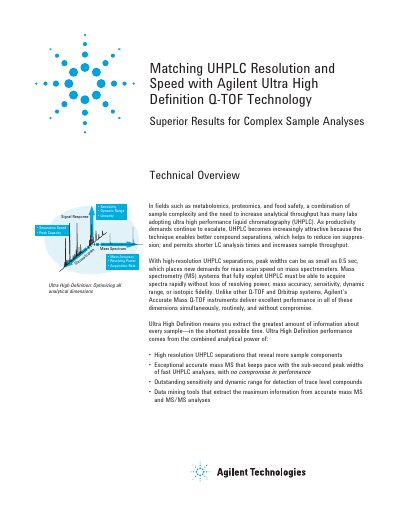
This document provides a technical overview of Agilent Ultra High Definition Q-TOF technology, specifically within the Agilent 6500 Series Accurate-Mass Q-TOF LC/MS Systems. It explains how the system optimizes the combination of ultra high performance liquid chromatography (UHPLC) resolution and speed to deliver superior results for complex sample analyses in fields such as metabolomics, proteomics, and food safety.
| Mass accuracy (MS) | 250 ppb |
|---|---|
| Mass accuracy (MS/MS) | < 700 ppb |
| Mass resolving power | 40,000 |
| MS spectra acquisition rate | up to 20 per second |
| MS/MS spectra acquisition rate | 10 per second |
| Dynamic range | five orders of magnitude |
| Sensitivity level | high-femtogram level |
The mass accuracy for MS/MS spectra is less than 700 ppb.
The system provides a mass resolving power of 40,000.
The system can acquire up to 20 MS spectra per second.