
This document discusses the analysis of nitrosamines and their health effects, with a focus on the use of the Agilent 255 Nitrogen Chemiluminescence Detector for nitrosamine analysis.
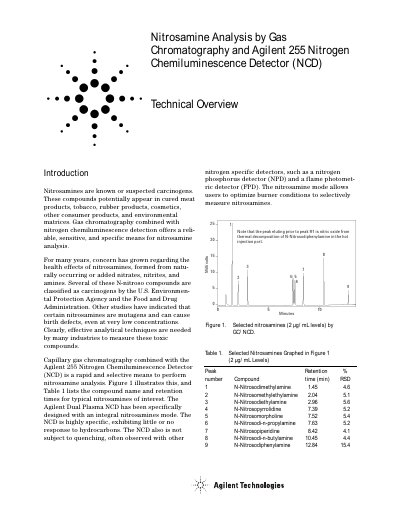
This document introduces the Agilent 255 Nitrogen Chemiluminescence Detector (NCD) as a reliable and specific method for analyzing nitrosamines, which are known or suspected carcinogens found in various consumer products and environmental matrices. The detector is highlighted for its high specificity to nitrogen compounds and lack of response to hydrocarbons, making it suitable for detecting low concentrations of these toxic compounds.
| Detector Type | Nitrogen Chemiluminescence Detector (NCD) |
|---|---|
| Analysis Target | Nitrosamines |
| Column Length (HP-5) | 30m |
| Column Length (DB-WAX) | 30m |
| Injection Volume (HP-5) | 1 uL |
| Injection Volume (DB-WAX) | 2 uL |
The NCD response to nitrogen compounds is equimolar, whereas NPD response can vary by as much as 30-fold depending on how the nitrogen is bound.
The NCD is linear over at least four orders of magnitude.