
This document introduces the application of ICP-MS in food safety, including the characteristics of ICP-MS, the advantages of combining with LC, and case studies of its application in food safety.
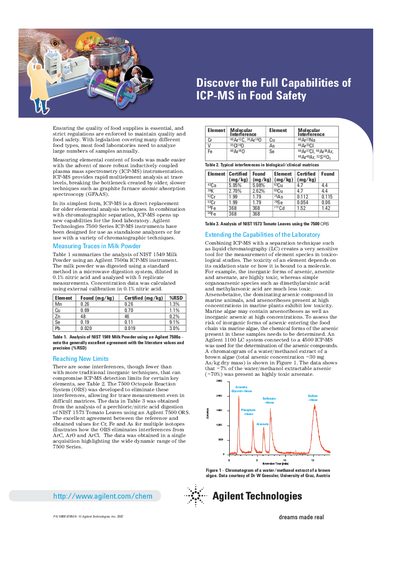
This document describes how Agilent Technologies 7500 Series ICP-MS instruments ensure food safety by providing rapid multielement analysis at trace levels. It serves as a direct replacement for older techniques like graphite furnace atomic absorption spectroscopy.
| Instrument Series | 7500 Series |
|---|---|
| Analysis Type | rapid multielement analysis at trace levels |
| Interference Elimination | 7500 Octopole Reaction System (ORS) |
It is designed for use as standalone analyzers or for use with a variety of chromatographic techniques.
It eliminates interferences from ArC, ArO, and ArCl, allowing for trace measurement even in difficult matrices.