
This document describes the method of rapidly analyzing and quantifying sulfur dioxide (SO2) in beer using a sulfur chemiluminescence detector (SCD) and headspace gas chromatography. It also mentions the importance of SO2 in the brewing process and the impact of SO2 concentration on beer quality and shelf life.
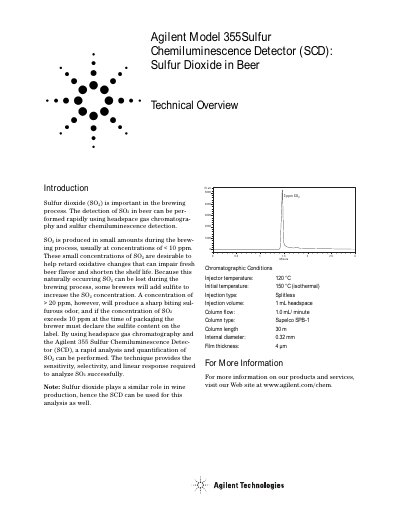
This document describes the application of the Agilent 355 Sulfur Chemiluminescence Detector (SCD) for the rapid analysis and quantification of sulfur dioxide (SO2) in beer. It explains the importance of SO2 in the brewing process, noting that concentrations below 10 ppm are desirable to retard oxidative changes, while concentrations exceeding 10 ppm at packaging require sulfite declaration on the label. The detector provides the necessary sensitivity, selectivity, and linear response for this analysis.
| Injector temperature | 120°C |
|---|---|
| Initial temperature | 150 °C (isothermal) |
| Injection volume | 1 mL headspace |
| Column type | Supelco SPB-1 |
| Column length | 30m |
| Internal diameter | 0.32 mm |
| Film thickness | 4um |
If the concentration exceeds 10 ppm at the time of packaging, the brewer must declare the sulfite content.
The procedure requires an injection volume of 1 mL headspace.