
Agilent NMR System 13C CPMAS with the Agilent NMR System,introduces the advantages of using Agilent NMR System for 13C CPMAS. The experiment used Agilent 400 MHz NMR system and Agilent 3.2 mm T3 HFXY probe, and obtained the HMB test spectrum.
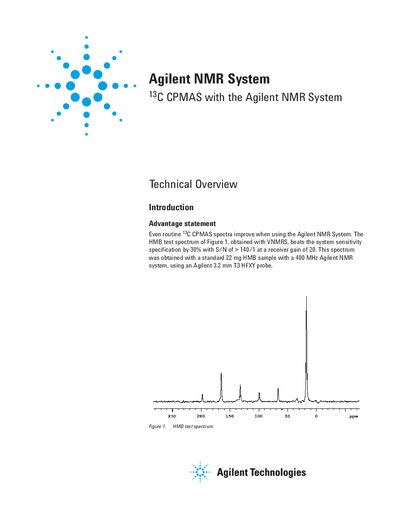
This document provides a technical overview of the Agilent NMR System, specifically focusing on 13C CPMAS applications. It demonstrates that routine spectra improve significantly when using the system, citing a test spectrum of HMB that beats system sensitivity specifications by 30% with a signal-to-noise ratio greater than 140/1. The data was obtained using a standard 22 mg HMB sample with a 400 MHz Agilent NMR system and an Agilent 3.2 mm T3 HFXY probe.
| System Frequency | 400 MHz |
|---|---|
| Probe Type | 3.2 mm T3 HFXY probe |
| Sample Mass | 22 mg |
| Receiver Gain | 20 |
| Signal-to-Noise Ratio | > 140/1 |
| Sensitivity Improvement | 30% |
| Sampling Rate | 80 MHz |
The signal-to-noise ratio is greater than 140/1.
Routine spectra improve by beating the system sensitivity specification by 30%.
An Agilent 3.2 mm T3 HFXY probe was used.