
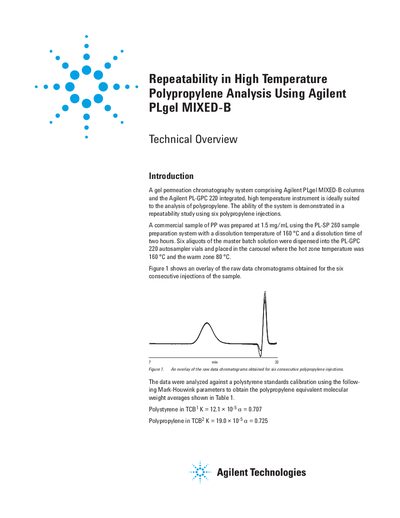
This document presents a repeatability study of polypropylene analysis using Agilent PLgel MIXED-B columns and the Agilent PL-GPC 220 integrated, high temperature instrument. The system's ability is demonstrated through the analysis of six polypropylene injections. A commercial sample of polypropylene was prepared at 1.5 mg/mL using the PL-SP 260 sample preparation system with a dissolution temperature of 160 °C and a dissolution time of two hours. Six aliquots of the master batch solution were dispensed into the PL-GPC 220 autosampler vials and placed in the carousel where the hot zone temperature was 160 °C and the warm zone was 80 °C. Figure 1 shows an overlay of the raw data chromatograms obtained for the six consecutive injections of the sample. The data were analyzed against a polystyrene standards calibration using the provided Mark-Houwink parameters to obtain the polypropylene equivalent molecular weight averages shown in Table 1.
This document presents a technical study on the repeatability of high-temperature polypropylene analysis. It utilizes an Agilent gel permeation chromatography system comprising Agilent PLgel MIXED-B columns and the Agilent PL-GPC 220 integrated, high temperature instrument.
The study involved six consecutive injections of a commercial polypropylene sample prepared at 160 °C. Data were analyzed against polystyrene standards using specific Mark-Houwink parameters to calculate molecular weight averages (Mp, Mn, Mw) and their variations.
| Columns | 3 x Agilent PLgel 10 pm MIXED-B, 300 x 7.5 mm |
|---|---|
| Part Number | PL1110-6100 |
| Eluent | TCB + 0.0125% BHT |
| Flow rate | 1.0 mL/min |
| Injection volume | 200 pL |
| Temperature | 160 °C |
| System | Agilent PL-GPC 220 |
The system operates with a flow rate of 1.0 mL/min.
The sample preparation requires a dissolution temperature of 160 °C.
The procedure specifies an injection volume of 200 pL.