
This document introduces the characteristics and usage methods of the Agilent Bio SEC-3 column, including safety precautions, installation methods and column information.
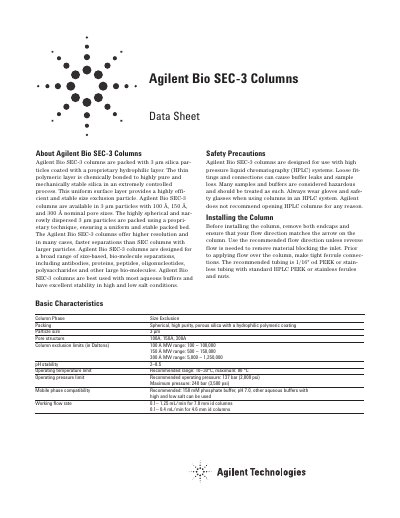
The Agilent Bio SEC-3 columns are designed for high-pressure liquid chromatography (HPLC) systems, utilizing 3 µm silica particles coated with a proprietary hydrophilic layer. These columns are optimized for the size exclusion separation of large biomolecules such as antibodies, proteins, peptides, and oligonucleotides.
| Particle size | 3 µm |
|---|---|
| Pore sizes | 100 Å, 150 Å, 300 Å |
| pH stability | 2–8.5 |
| Operating temperature limit | 80 °C |
| Operating pressure limit | 137 bar (2,000 psi) |
| Maximum pressure | 240 bar (3,500 psi) |
| Working flow rate (7.8 mm id) | 0.1–1.25 mL/min |
| Working flow rate (4.6 mm id) | 0.1–0.4 mL/min |
These columns are designed for antibodies, proteins, peptides, oligonucleotides, polysaccharides and other large bio-molecules.
The columns can be used in the range pH 2–8.5 to optimize performance and lifetime.
Flush the column in a 0.05% NaN3 or 20% ethanol containing buffer at pH 7.0 and seal both ends with removable end plugs.