
This document introduces Part Four of the GC Troubleshooting Series released by Agilent Technologies, Inc. in 2009: Tailing Peaks. It emphasizes the importance of routine inlet maintenance to prevent tailing issues, and suggests using sample preparation techniques such as SPE or filtration to avoid peak tailing. It also highlights the benefits of using guard columns and the Agilent J&W Duraguard columns to capture sample contaminants and increase column lifetime.
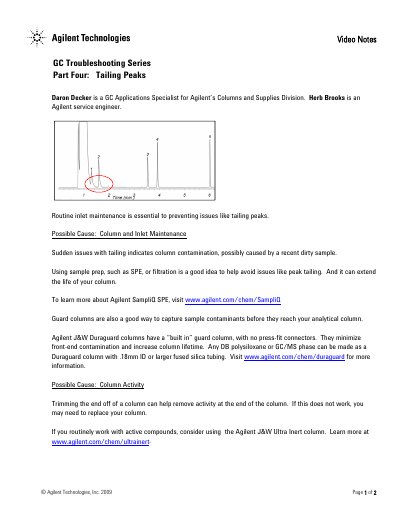
This document is part of the Agilent GC Troubleshooting Series, specifically Part Four focusing on Tailing Peaks. It features insights from Daron Decker, a GC Applications Specialist for Agilent's Columns and Supplies Division, and Herb Brooks, an Agilent service engineer.
The notes outline several potential causes for peak tailing in Gas Chromatography (GC) analysis. Key issues identified include inlet contamination due to dirty samples or lack of sample preparation, column activity at the end of the column, physical blockages within the column, improper column installation, and solvent-related problems such as polarity mismatch, reverse solvent effect, and solvent effect violations during splitless injections.
You will want a minimum of 20 mL/minute of total flow through the inlet.
Inject something with no known tailing; if that compound tails, you have a blockage.
Decrease your initial column temperature by 10 — 20 degrees to get a better focusing effect.