
DS90CP22 is a 2x2 crosspoint switch utilizing LVDS technology for low power, high speed operation. Data paths are fully differential from input to output for low noise generation and low pulse width distortion. The non-blocking design allows connection of any input to any output or outputs. LVDS I/O enable high speed data transmission for point-to-point interconnects. This device can be used as a high speed differential crosspoint, 2:1 mux, 1:2 demux, repeater or 1:2 signal splitter. The mux and demux functions are useful for switching between primary and backup circuits in fault tolerant systems. The 1:2 signal splitter and 2:1 mux functions are useful for distribution of serial bus across several rack-mounted backplanes.
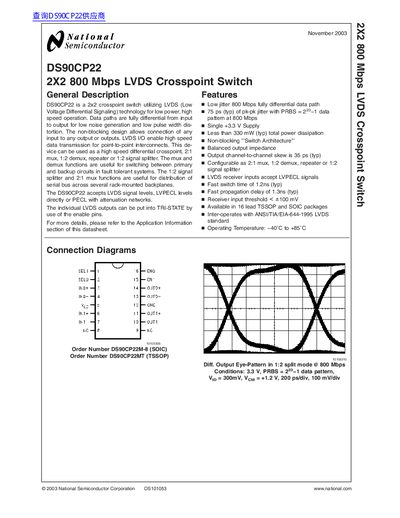
The DS90CP22 is a 2x2 crosspoint switch utilizing LVDS technology for low power, high-speed operation. It features a non-blocking design that allows any input to connect to any output or outputs, supporting functions such as 2:1 mux, 1:2 demux, repeater, or 1:2 signal splitter. The device accepts LVDS, LVPECL, or PECL signals and allows individual outputs to be placed in a TRI-STATE mode via enable pins.
| Data Rate | 800 Mbps |
|---|---|
| Supply Voltage | 3.3 V |
| Total Power Dissipation | 330 mW |
| Switch Time | 1.2 ns |
| Propagation Delay | 1.3 ns |
| Operating Temperature | -40°C to +85°C |
| Package Types | 16 lead TSSOP and SOIC |
It can be configured as a 2:1 mux, 1:2 demux, repeater, or 1:2 signal splitter.
The device accepts LVDS signal levels, LVPECL levels directly, or PECL with attenuation networks.
Yes, the individual LVDS outputs can be put into TRI-STATE by use of the enable pins.