
The DS90C032 is a low power, high speed, quad channel LVDS receiver from Texas Instruments.
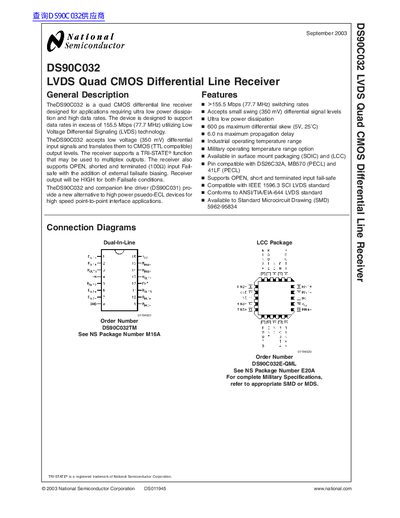
The DS90C032 is a quad CMOS differential line receiver designed for applications requiring ultra low power dissipation and high data rates. It supports data rates in excess of 155.5 Mbps (77.7 MHz) utilizing Low Voltage Differential Signaling (LVDS) technology. The device accepts low voltage (350 mV) differential input signals and translates them to CMOS (TTL compatible) output levels.
| Data Rate | >155.5 Mbps (77.7 MHz) |
|---|---|
| Input Voltage | 350 mV differential |
| Output Level | CMOS (TTL compatible) |
| Supply Voltage | +45 to +45.5 V |
| Operating Temperature (Industrial) | -40°C to +85°C |
| Propagation Delay (Typical) | 6.0 ns |
The device supports data rates in excess of 155.5 Mbps (77.7 MHz).
It accepts low voltage (350 mV) differential input signals.
The receiver translates inputs to CMOS (TTL compatible) output levels.
Yes, it supports OPEN, shorted and terminated input fail-safe with external biasing.