
This paper describes an HPLC method for the separation of three common keratolytic drugs. The method uses a reversed-phase column and UV detection, and a detector program is used because of the different absorbance maxima of the compounds.
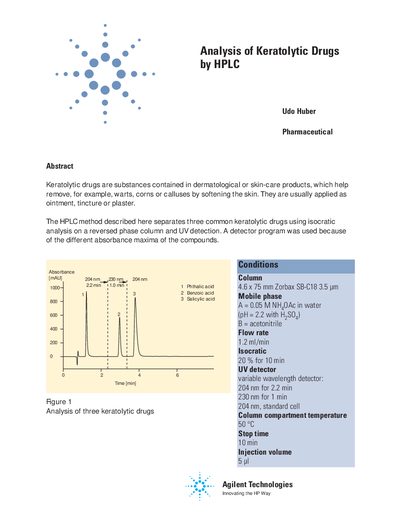
This document presents an HPLC method for the separation and analysis of three common keratolytic drugs: phthalic acid, benzoic acid, and salicylic acid. The method utilizes isocratic analysis on a reversed phase column with UV detection at variable wavelengths (204 nm and 230 nm) to accommodate the different absorbance maxima of the compounds.
The analysis was specifically developed on the Agilent 1100 Series system. The document details the required equipment, including the quaternary pump, autosampler, thermostatted column compartment, and variable wavelength detector. It also provides specific chromatographic conditions, such as the column type (Zorbax SB-C18), mobile phase composition, flow rate, and temperature settings. Performance data, including limits of detection (LOD) and precision for retention time and area, are provided for the three analytes.
| Column | 4.6 x 75 mm Zorbax SB-C18 3.5 ym |
|---|---|
| Mobile phase B | acetonitrile |
| Flow rate | 1.2 ml/min |
| Column temperature | 50 °C |
| Injection volume | 5 ul |
| Stop time | 10 min |
| Phthalic acid LOD | 2.0 mg/l |
| Benzoic acid LOD | 2.0 mg/l |
| Salicylic acid LOD | 2.0 mg/l |
The method was specifically developed on the Agilent 1100 Series system.
The method separates phthalic acid, benzoic acid, and salicylic acid.
The flow rate is set to 1.2 ml/min.
The analysis runs for a stop time of 10 min.