
LC/MS analysis method of chloramphenicol, including chromatographic conditions, sample solvent, injection volume and other information
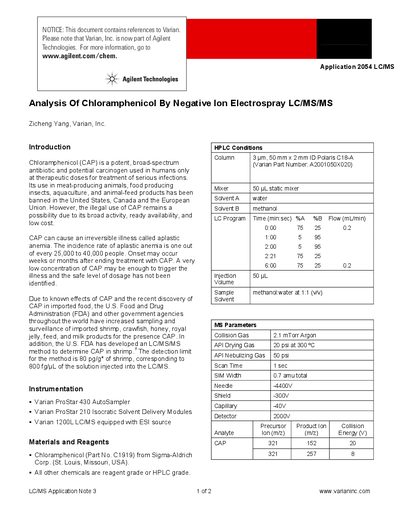
The document details a method for detecting chloramphenicol (CAP), a banned antibiotic, in food products like shrimp. It outlines specific HPLC conditions and LC/MS parameters used to achieve high sensitivity and reproducibility.
Results indicate that the system can detect CAP at levels below 30 fg/uL in solution (<3 pg/g in shrimp). The method demonstrates excellent linearity with R² values of 0.999 and 0.998 for specific ion transitions.
The detection limit is estimated to be less than 30 fg/uL in solution, which corresponds to a level of less than 3 pg/g in shrimp.
The method uses a 6 minute run cycle where chloramphenicol gives a retention time of 3.1 minutes.