
This article introduces a HPLC technique for the analysis of antiprotozoal drugs.
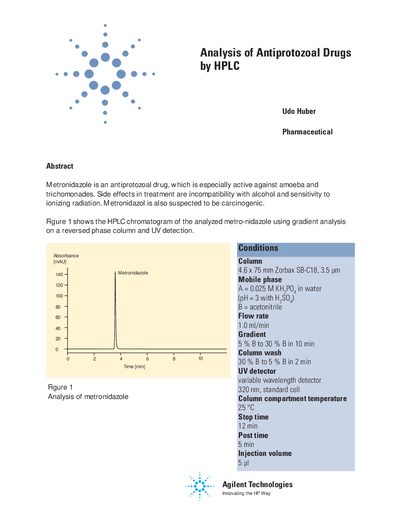
The document presents a High-Performance Liquid Chromatography (HPLC) method specifically developed on the Agilent 1100 Series system to analyze the antiprotozoal drug metronidazole. The method utilizes a Zorbax SB-C18 column, a variable wavelength detector set at 320 nm, and a gradient mobile phase of potassium hydrogen phosphate in water and acetonitrile.
| Column | 4.6 x 75 mm Zorbax SB-C18, 3.5 um |
|---|---|
| Mobile phase A | 0.025 M KH2PO4 in water (pH = 3 with H2SO4) |
| Mobile phase B | acetonitrile |
| Flow rate | 1.0 ml/min |
| UV detector wavelength | 320 nm |
| Column temperature | 25 °C |
| Injection volume | 5 ul |
The limit of detection (LOD) for metronidazole using this method is 0.1 mg/l.
Metronidazole is an antiprotozoal drug that is especially active against amoeba and trichomonades.
Side effects include incompatibility with alcohol, sensitivity to ionizing radiation, and suspected carcinogenicity.
The procedure specifies an injection volume of 5 ul.