
This paper studies the method for HPLC analysis of the antitussive drug effect, the method adopts the reversed phase column chromatography separation, UV detection, the results show that the method accuracy is high, repeatability is good.
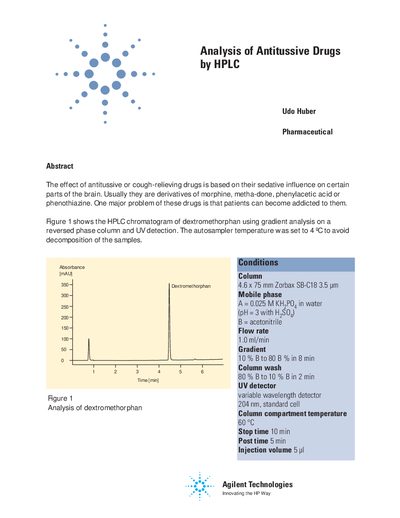
This document presents an HPLC method for the analysis of the antitussive drug dextromethorphan. The method utilizes a reversed-phase column and UV detection, with specific conditions detailed to ensure reliable results. The chromatogram demonstrates the separation of dextromethorphan under the specified gradient elution conditions.
| Mobile phase A | 0.025 M KH2PO4 in water (pH = 3 with H2SO4) |
|---|---|
| Mobile phase B | acetonitrile |
| Flow rate | 1.0 ml/min |
| Gradient | 10 % B to 80 B % in 8 min |
| UV detector wavelength | 204 nm |
| Column compartment temperature | 60 °C |
| Injection volume | 5 ul |
| LOD | 0.1 mg/I |
The method uses an Agilent 1100 Series system including a quaternary pump, thermostatted autosampler, thermostatted column compartment, and variable wavelength detector.
The recommended column is Zorbax SB-C18, 3.5 um, 4.6 x 75 mm (Agilent part number 866953-902).
A cooled autosampler is necessary to avoid decomposition of the samples during analysis.