
Quantitative determination of antiepileptic drugs in biological fluids using HPLC is an important way to facilitate the individualization of dosage.
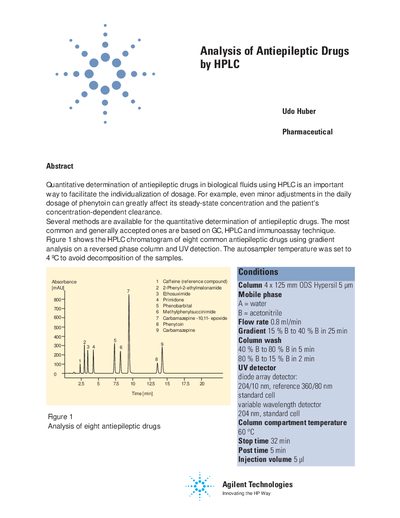
The document presents a High-Performance Liquid Chromatography (HPLC) method for the quantitative analysis of eight common antiepileptic drugs, including phenytoin, carbamazepine, and phenobarbital. The method utilizes gradient analysis on a reversed-phase column with UV detection to facilitate dosage individualization.
The performance of the method is detailed in a table showing limits of detection (LOD), retention time precision, area precision, and linearity factors for each compound. The procedure specifies conditions such as an autosampler temperature of 4°C, a flow rate of 0.8 ml/min, and specific gradient steps using water and acetonitrile.
The procedure requires an injection volume of 5 µl.
The autosampler temperature must be set to 4°C to avoid decomposition of the samples.
The method uses a flow rate of 0.8 ml/min.