
This paper introduces the ability of the Agilent 1100 Capillary LC system to handle small sample volumes accurately and reproducibly. By reducing the internal diameter of the LC column to capillary dimensions, sensitivity can be increased. The experimental results show that the system is capable of accurately and reproducibly handling 100 nL sample injections. Excellent data on precision, linearity, and repeatability are given for a mixture of tricyclic antidepressants as exemplary analytes.
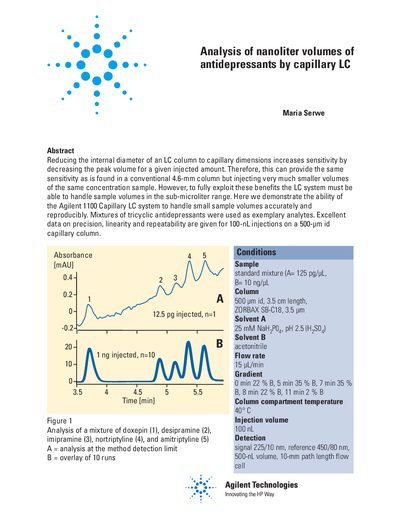
This document describes the analysis of nanoliter volumes of tricyclic antidepressants using the Agilent 1100 Capillary LC system. By reducing the internal diameter of the LC column to capillary dimensions, the system achieves high sensitivity with very small injected sample volumes, comparable to conventional 4.6-mm columns.
The text details the experimental setup, including the use of a ZORBAX SB-C18 column and specific solvent conditions. Results show excellent precision and linearity for 100-nL injections, with relative standard deviations (RSD) for retention time of less than 0.5% and for area of less than 2%.
| Column ID | 500 um |
|---|---|
| Column Length | 3.5 cm |
| Column Type | ZORBAX SB-C18 |
| Flow Rate | 15 uL/min |
| Column Temperature | 40° C |
| Flow Cell Volume | 500-nL |
An Agilent 1100 Series Capillary LC system with Agilent ChemStation for instrument control, data acquisition and analysis.
The assay was linear in a range from 125 pg/uL to 4 ng/pL with an r2 greater than 0.999.