
This document introduces the separation results of Agilent Technologies' SB-C18, SB-C8, SB-C3, and SB-CN columns at 0-70% B in 36 minutes, and compares them with the separation results on 300Å StableBond columns.
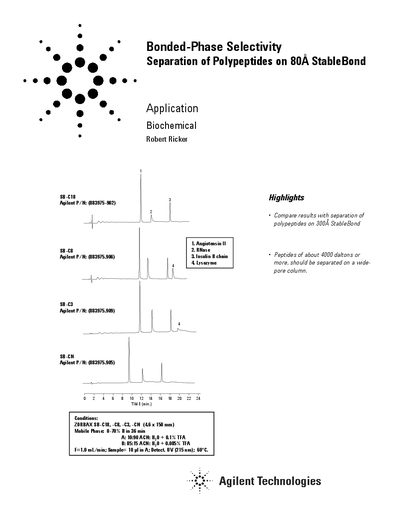
This document presents an application for separating various polypeptides, including Angiotensin II, RNase, and the Insulin B chain. The study compares separation results achieved on 80Å StableBond bonded phases against those obtained on 300Å StableBond phases.
The analysis utilizes ZORBAX SB-C18, -C8, -C3, and -CN columns with dimensions of 4.6 x 150 mm. The method employs a mobile phase gradient increasing from 0% to 70% solvent B over 36 minutes, with detection performed via UV at 215 nm.
| Column Dimensions | 4.6 x 150 mm |
|---|---|
| Flow Rate | 1.0 mL/min |
| Injection Volume | 10 pl |
| Detection Wavelength | 215 nm |
The document lists Angiotensin II, RNase, and Insulin B chain as the samples analyzed.
Peptides of this molecular weight should be separated on a wide-pore column.