
This document describes the method for catecholamine analysis using Agilent ZORBAX SB-C18 column
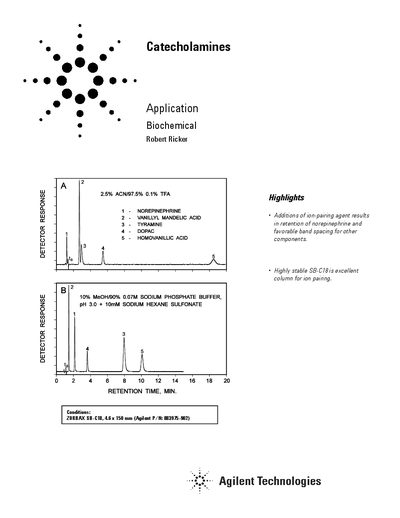
The document outlines an analytical method for the detection of catecholamines, including norepinephrine and related compounds like vanillyl mandelic acid. The method utilizes a specific mobile phase composition involving sodium hexane sulfonate as an ion-pairing agent to achieve favorable retention and band spacing.
Key highlights include the use of a highly stable SB-C18 column (Agilent P/N: 883975-902) and optimized pH conditions. The chromatogram demonstrates the separation efficiency achieved with these parameters.
The document lists norepinephrine, vanillyl mandelic acid, tyramine, DOPAC, and homovanillic acid as the target biochemical catecholamines.
The specified ZORBAX SB-C18 column must be 4.6 x 150 mm in size.
The method uses a sodium phosphate buffer adjusted to a pH of 3.0.