
This application note briefly introduces derivative spectroscopy and illustrates its features and applications using computer-generated examples.
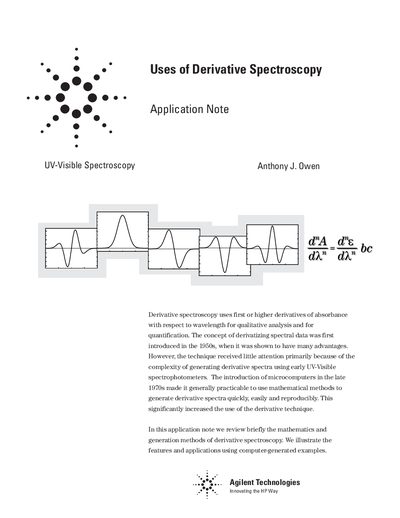
This document explains the concept of derivative spectroscopy, which uses first or higher derivatives of absorbance with respect to wavelength for qualitative analysis and quantification. It details how the introduction of microcomputers made generating derivative spectra quickly and reproducibly possible. The text covers the mathematical basis of derivatization and compares different generation methods, including optical, electronic, and mathematical techniques.
Derivative spectra may be easily calculated and recalculated with different parameters, and smoothing techniques may be used to improve the signal-to-noise ratio.
Using the first-derivative spectra eliminates baseline shifts because the first derivative of a constant absorbance offset is zero.