
This Application Note describes how an evaporative light scattering detector (ELSD) can be used with the Agilent 1100 Series purification system for peak-based fraction collection. The system setup is described, and an example is shown of how an ELSD can be used with the Agilent 1100 Series purification system for peak-based fraction collection.
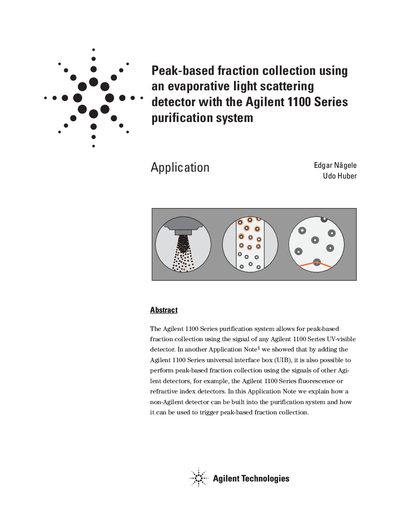
This document describes a method for performing peak-based fraction collection using an evaporative light scattering detector (ELSD) or other non-Agilent detectors with the Agilent 1100 Series purification system. It details the system setup, including the use of a splitter and a universal interface box (UIB) to connect the external detector signal to the ChemStation software.
The ELSD is used to detect compounds that have no chromophoric group, making it ideal for purity checks.
The example demonstrates the separation of four glucocorticoid standards: Prednisolone, Betamethasone, Prednisolone acetate, and Betamethasone valerate.
The ELSD was operated at a temperature of 45 °C with a nitrogen pressure of 2 bar and a gain setting of 8.