
This is an example of using high temperature reversed-phase liquid chromatography to separate and purify amyloid peptide ab (1-42). This method takes advantage of isocratic separation (no re-equilibration time) using highly efficient 3.5 µm particle diameter, 300Å pore size, Agilent ZORBAX SB-C18 column packing material. High temperature separation enhances recovery and improves peak shape for this badly behaved peptide.
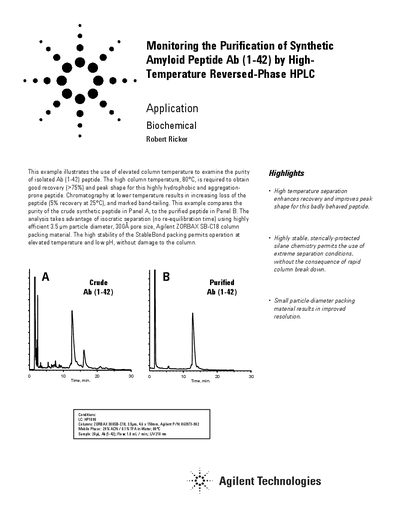
This document illustrates the use of elevated column temperature to examine the purity of isolated Ab (1-42) peptide. The high column temperature of 80°C is required to obtain good recovery (>75%) and peak shape for this highly hydrophobic and aggregation-prone peptide. Chromatography at lower temperature results in increasing loss of the peptide and marked band-tailing. The analysis compares the purity of the crude synthetic peptide to the purified peptide using isocratic separation.
| Column Temperature | 80°C |
|---|---|
| Recovery Rate | >75% |
| Column Type | Agilent ZORBAX SB-C18 |
| Particle Diameter | 3.5 um |
| Pore Size | 300A |
| Column Dimensions | 4.6 x 150mm |
| Column Length | 3.5m |
| Mobile Phase Composition | 29% ACN / 0.1% TFA in Water |
| Detection Wavelength | 210 nm |
| Recovery at 25°C | 5% |
High temperature is required to obtain good recovery and peak shape for this highly hydrophobic and aggregation-prone peptide.
Chromatography at lower temperature results in increasing loss of the peptide and marked band-tailing.
The analysis uses an Agilent ZORBAX SB-C18 column with 3.5 um particle diameter and 300A pore size.