
This document describes the complete separation of ß-amyloid peptides (ßAP) using Agilent ZORBAX 300 SB-C8 column. The inset box shows the high recovery following the HPLC separation, as determined by direct protein assay of collected peaks. The separation of these peptides was not possible at column temperatures below 80°C. High-resolution separation of human amyloid Aß peptides highlights: • Sterically-protected bonded phases (StableBond) permit use of low pH mobile phases, even at high temperature. • Use of elevated column temperature can dramatically improve separation and recoveries of difficult samples. • Note the greater retention of ßAP(1- 42) than ßAP(1-43). Application Biochemical Robert Ricker Conditions: ZORBAX 300 SB-C8, 4.6 mm ID x 250 mm, Agilent Part No. 880995-906 Mobile Phase: 80°C; 0.1% TFA in 30.5% acetonitrile / 69.5% water 2.5 µg each peptide in 20 µL 6 M urea / 5% HOAc Flow: 1 mL/min. Absorbance (210 nm) ßAP(1-38) ßAP(1-43) ßAP(1-40) ßAP(1-42) Time (min.) Rs = 2.52 0 4 8 12 16 20 Recovery (% ± S.D., n = 3) 1-38 111 ± 14 1-40 96 ± 14 1-42 75 ± 10 1-43 69 ± 10 Copyright© 2002 Agilent Technologies, Inc. All Rights Reserved. Reproduction, adaptation or translation without prior written permission is prohibited, except as allowed under the copyright laws. For more information on our products and services, visit our website at: www.agilent.com/chem Robert Ricker is an application chemist based at Agilent Technologies, Wilmington, Delaware. Agilent shall no
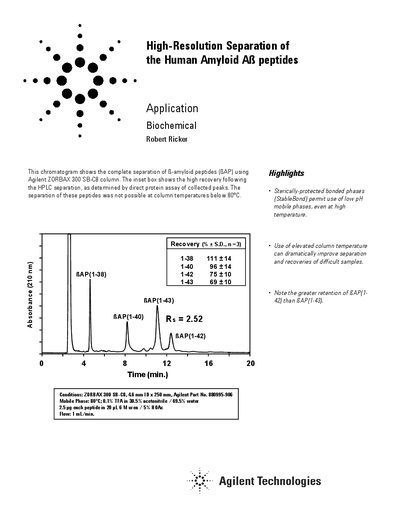
This document presents a chromatogram showing the complete separation of R-amyloid peptides (RAP) and BAP variants. The analysis was performed using an Agilent ZORBAX 300 SB-C8 column under specific high-temperature conditions.
Key highlights include the use of sterically-protected bonded phases to allow low pH mobile phases at elevated temperatures, which dramatically improves separation and recovery for difficult samples like amyloid peptides.
The column used has an inner diameter of 4.6 mm and a length of 250 mm.
The flow rate for the separation procedure is 1 mL/min.