
Size-exclusion chromatography is a powerful technique for the size-dependent separation of biomolecules. While standard, non-denaturing mobile phases are often desirable, denaturing mobile phases containing guanidine hydrochloride (or SDS), may be used to insure un-aggregated, monomers for proper size determination. As shown below, denaturation shifts molecules toward larger apparent size and smaller retention volume.
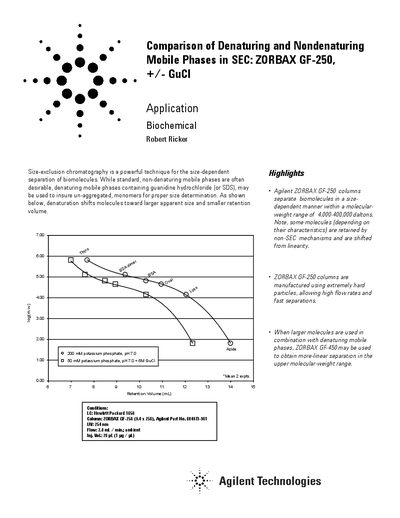
The document discusses size-exclusion chromatography (SEC) as a technique for separating biomolecules based on size. It explains that while standard non-denaturing mobile phases are often preferred, denaturing mobile phases containing guanidine hydrochloride or SDS can be used to ensure un-aggregated monomers for accurate size determination. The text notes that denaturation shifts molecules toward larger apparent sizes and smaller retention volumes.
The columns separate biomolecules within a molecular-weight range of 4,000-400,000 daltons.
The recommended flow rate is 2.0 mL / min.
The recommended injection volume is 20 pL.