
This document describes the separation method for tricyclic antidepressants and their metabolites. It explains that good peak shapes can be obtained for very basic compounds at pH 6.2 by adding TEA. The document also suggests that changing the pore-size and surface area of the column packing can help achieve the desired separation. Specific analysis conditions and methods are provided.
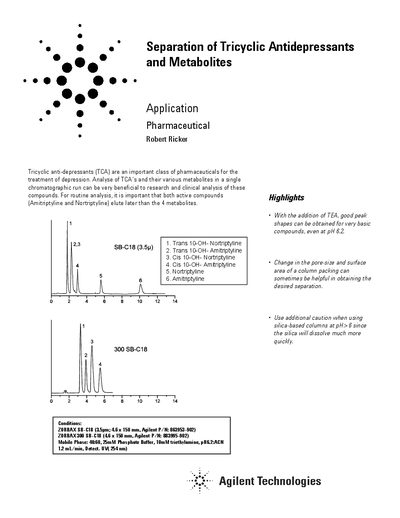
This document presents a chromatographic application for the analysis of tricyclic antidepressants (TCAs) and their metabolites. The method is designed to separate active compounds like Amitriptyline and Nortriptyline from their metabolites in a single run, which is beneficial for research and clinical analysis. The procedure utilizes ZORBAX SB-C18 columns with specific mobile phase conditions to achieve good peak shapes for basic compounds.
| Column Part Number | 863953-902 |
|---|---|
| Column Dimensions | 4.6 x 150 mm |
| Mobile Phase Ratio | 40:60 |
| Detection Wavelength | 254 nm |
With the addition of TEA, good peak shapes can be obtained for very basic compounds, even at pH 6.2.
Use additional caution when using silica-based columns at pH> 6 since the silica will dissolve much more quickly.