
The document describes the separation method for extracting morphine and its metabolites from blood plasma. Good resolution and peak shape for morphine and two metabolites can be achieved using ZORBAX SB-C18 at moderate pH. Morphine and the metabolite morphine-6-glucuronide can be sensitively detected using electrochemical detection, while morphine-3-glucuronide can be sensitively detected using fluorescence.
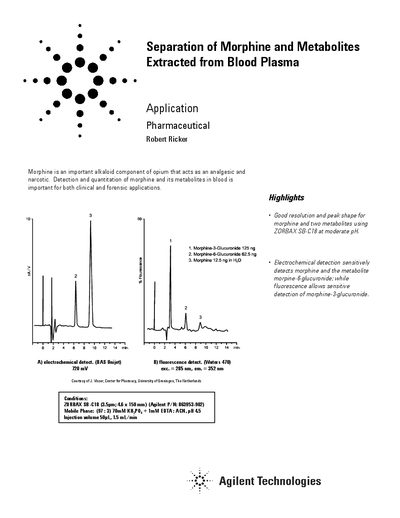
This document details a method for the detection and quantitation of morphine and its metabolites in blood plasma, relevant for clinical and forensic applications. The procedure utilizes a ZORBAX SB-C18 column with a mobile phase of 70mM KH2PO4, 1mM EDTA, and acetonitrile at pH 4.5. Detection is performed using either electrochemical detection (BAS Unijet) or fluorescence detection (Waters 470).
| Column | ZORBAX SB-C18 (3.5m; 4.6 x 150 mm) |
|---|---|
| Mobile Phase | (97 : 3) 70mM KH2PO4 + 1mM EDTA : ACN, pH 4.5 |
| Injection Volume | 50uL |
| Flow Rate | 1.5 mL/min |
| Excitation Wavelength | 720 mV exc. |
| Emission Wavelength | em. = 352 nm |
Detection and quantitation of morphine and its metabolites in blood is important for both clinical and forensic applications.
Electrochemical detection sensitively detects morphine and morphine-6-glucuronide, while fluorescence allows sensitive detection of morphine-3-glucuronide.
No, this procedure is for Investigational / Research only and is not for in vitro diagnostic procedures.