
This document discusses the risks of residual solvents in pharmaceutical products and the regulatory requirements from national and international bodies. The use of Agilent 7890A GC and Agilent G1888 automated headspace sampler allows for sensitive and accurate analysis of solvent residues. The document provides details on experimental conditions and instrument parameters.
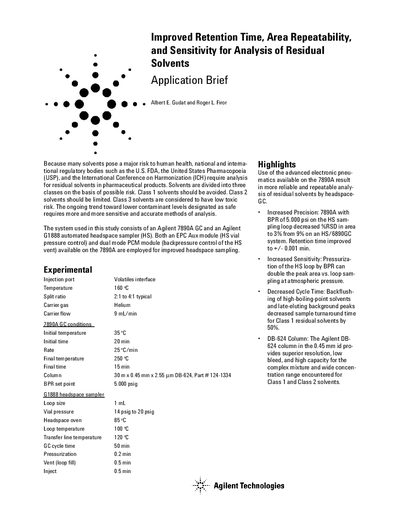
This document describes an application using the Agilent 7890A Gas Chromatograph (GC) and G1888 automated headspace sampler to analyze residual solvents in pharmaceutical products. The system utilizes advanced electronic pneumatics, including an EPC Aux module and dual mode PCM module, to address issues with area precision, sensitivity, and cycle time.
| Injection port temperature | 160°C |
|---|---|
| Split ratio | 2:1 to 4:1 typical |
| Carrier gas | Helium |
| Carrier flow | 9 mL/min |
| Initial temperature | 36°C |
| Initial time | 20 min |
| Rate | 25 °C/min |
| Final temperature | 250°C |
| Final time | 16 min |
| Column | 30 mx 0.45 mm x 2.55 um DB-624 |
| Vial pressure | 14 psig to 20 psig |
| Headspace oven temperature | 85°C |
| Loop temperature | 100°C |
| Transfer line temperature | 120°C |
| GC cycle time | 50 min |
The sample pressure in the gas sampling valve loop is controlled to within 0.001 psi by an electronic backpressure regulator (BPR).
Sensitivity is improved by pressurizing the sample in the loop of the gas sampling valve (GSV).
Implementation of a column backflush facilitated by capillary-flow-technology splitter and fast oven cooldown decreases sample turnaround time.