
Nanospray LC-MS analysis of dextromethorphan (DEM) and its metabolites was performed using the Agilent 1200 Series HPLC-Chip/TOF system. The high sensitivity TOF in combination with automated nanospray HPLC-Chips enabled the detection of all DEM metabolites at concentration levels 100-fold lower than normal. The system response was linear over a wide concentration range for metabolites even when spiked into human plasma and urine. The LODs for real-life samples were in the high attomol to low femtomol range. Sample preparation was simplified using acidic precipitation by perchloric acid and a short centrifugation step. The simplified sample preparation, accurate mass measurements, excellent chromatographic reproducibility, and easy-to-use nanospray chip system make this setup optimal for routine use, allowing for higher throughput and reduced sample preparation costs.
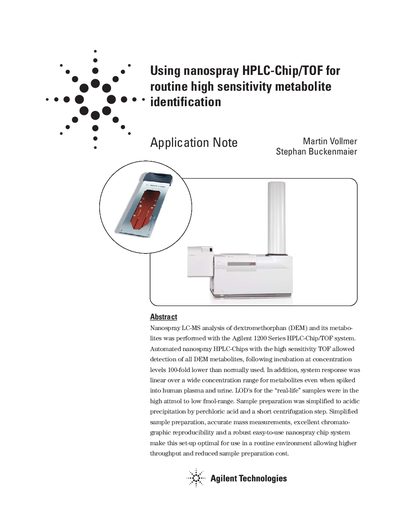
The document describes a method using the Agilent 1200 Series HPLC-Chip system coupled with an Agilent 6210 TOF LC/MS to analyze dextromethorphan (DEM) and its metabolites. The setup allows for detection at concentration levels 100-fold lower than normally used, achieving limits of detection in the high attmol to low fmol-range for real-life samples like plasma and urine.
The methodology simplifies sample preparation to acidic precipitation by perchloric acid followed by a short centrifugation step. The system utilizes automated nanospray HPLC-Chips with integrated enrichment columns, ensuring robustness and reliability for routine automated operation while maintaining high throughput.
| Enrichment column volume | 40 nL |
|---|---|
| Analytical column dimensions | 43 x 0.75 mm ID |
| Sample loading flow rate | 4 pL/min |
| Analysis flow rate | 0.6 pL/min |
| Drying gas temperature | 300 °C |
| Drying gas flow | 3.5 L/min |
| Capillary voltage | -1900 V |
The limits of detection (LOD's) for 'real-life' samples were in the high attmol to low fmol-range.
Sample preparation was simplified to acidic precipitation by perchloric acid and a short centrifugation step.
The entire system is controlled by the Agilent MassHunter software.