
This Application Note briefly describes the advantages of mass-based fraction collection compared to time and peak based fraction collection in combination with the Agilent 1200 Series purification system and the Agilent 6100 Single Quadrupole LC/MS
The document explains that modern automated purification systems offer various ways to collect fractions, including manual, time-based, peak-based, and mass-based methods. It focuses on comparing these techniques in the context of drug discovery and preparative HPLC.
Mass-based fraction collection is highlighted as a highly specific method where the fraction collector is triggered by a single quadrupole MSD based on a known target mass (e.g., [M+H]+). The note details that this approach typically results in only one fraction per sample, eliminating the need for subsequent analysis to identify which fraction contains the compound of interest. However, it notes that purity may be slightly lower than peak-based collection if isomers with identical masses are present.
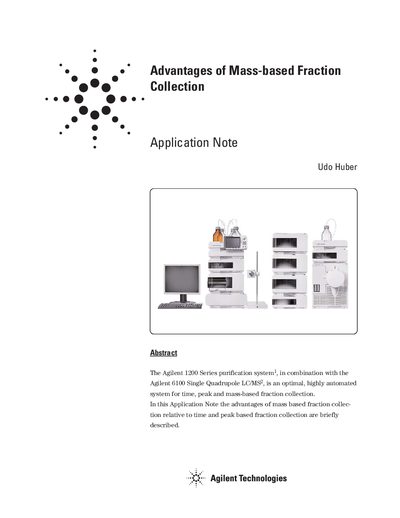
The Agilent 1200 Series purification system in combination with the Agilent 6100 Single Quadrupole LC/MS.
The Agilent 1200 Series purification system is used in combination with the Agilent 6100 Single Quadrupole LC/MS.
The user must know the mass of the target compound before starting the process.