
This document is about a high throughput HPLC method for separating xanthines. The method uses a simple isocratic HPLC method and can be used to analyze theobromine, theophylline and caffeine in liquid refreshments (tea, chocolate syrup, and cocoa).
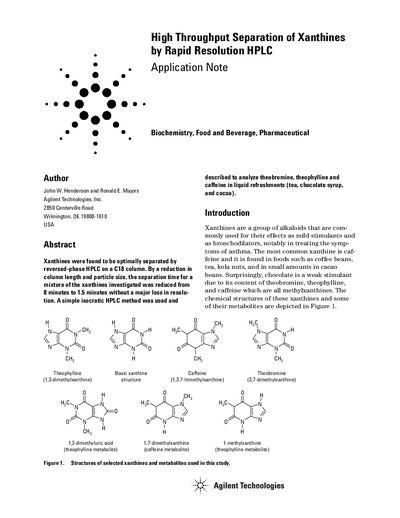
This document presents an application note detailing the high-throughput separation of xanthines, specifically theophylline, theobromine, and caffeine, using reversed-phase HPLC. The study focuses on optimizing separation speed by reducing column length and particle size while maintaining resolution. The authors demonstrate that using a ZORBAX SB-C18 column with smaller particles (1.8 µm) and shorter lengths (50 mm) reduces analysis time from 8 minutes to 1.5 minutes.
| Column Type | ZORBAX SB-C18 |
|---|---|
| Mobile Phase A | 0.2% Formic acid |
| Mobile Phase B | Acetonitrile with 0.2% Formic acid |
| Flow Rate | 1.5 mL/min |
| Detection Wavelength | 254 nm |
| Injection Volume | 2, 4, 6 µL |
The ZORBAX SB-C18 column provided the best overall separation in the shortest time.
Reducing column length and particle size reduces separation time from 8 minutes to 1.5 minutes without major loss in resolution.
The method was used to analyze theobromine, theophylline, and caffeine in liquid refreshments such as tea, chocolate syrup, and cocoa.