
This document describes a method for improving productivity and extending column life using backflush application. The method includes using a 3-way splitter to divide the column outlet into two branches, each of which is connected to a GC detector, as well as an MSD. This configuration provides full-scan data for library searching, SIM data for quantitation, and element selective detector data for excellent selectivity and sensitivity from complex matrices.
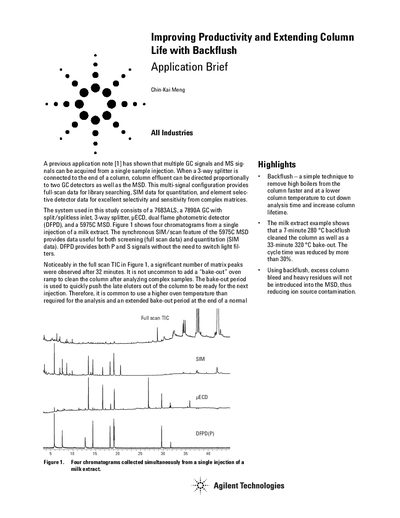
This document describes a technique called backflush to improve productivity and extend the life of gas chromatography (GC) columns. By reversing the column flow to push late-eluting compounds out of the inlet end, the method eliminates the need for extended high-temperature bake-out periods required to clean the column after complex sample analysis. This process significantly reduces the total cycle time and prevents heavy residues from contaminating the detector or subsequent runs.
The text illustrates these benefits using a milk extract analysis example. It compares a standard analysis requiring a 33-minute bake-out at 320 °C with a backflush method that uses a 7-minute post-run at 280 °C. The results show that backflushing cleans the column as effectively as the longer bake-out, reducing cycle time by more than 30% and minimizing ion source contamination in mass spectrometers.
| Cycle time reduction | more than 30% |
|---|---|
| Bake-out temperature | 320 °C |
| Bake-out duration | 33 minutes |
| Backflush duration | 7 minutes |
It reduces column bleed by eliminating the need for high-temperature bake-outs, which results in longer column life.
Yes, it minimizes contamination that goes into the detector, which is especially valuable for the MSD to reduce ion source cleaning.