
This article illustrates how time-of-flight mass spectrometry can be used in the safety evaluation of new and existing can coatings used in the food industry. The accurate mass provides information for the parent compound and fragment ions greatly increase the confidence in the identification process.
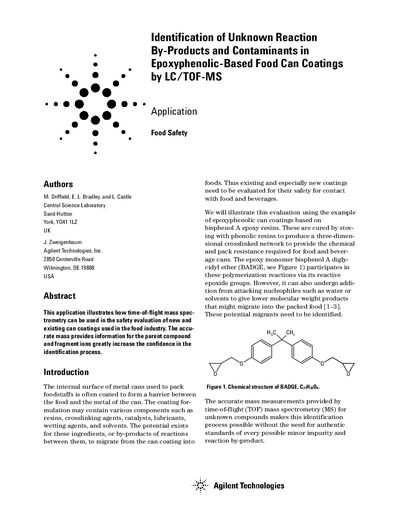
The document describes a method for evaluating the safety of new and existing can coatings used in the food industry. It focuses on identifying potential migrants from epoxyphenolic lacquers into foodstuffs, specifically those derived from bisphenol A diglycidyl ether (BADGE). The study utilizes liquid chromatography coupled with time-of-flight mass spectrometry (LC/TOF-MS) to analyze solvent extracts of coated metal panels.
This document illustrates how time-of-flight mass spectrometry can be used in the safety evaluation of new and existing can coatings used in the food industry.
The flow rate for the liquid chromatography conditions is 0.2 mL/min.
The gas temperature used in the mass spectrometry conditions was 300 °C.