
This document introduces the method for the detection of 3-chloro-1,2-propanediol (3-MCPD) in hydrolyzed vegetable protein.
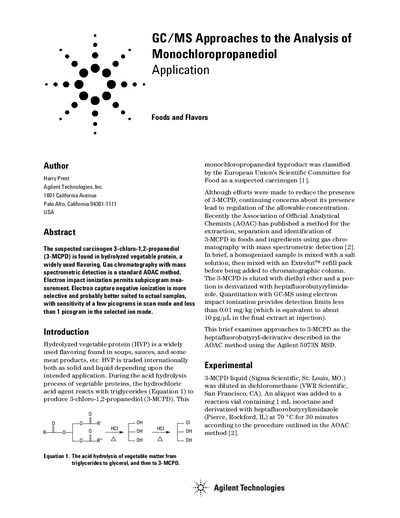
This document examines gas chromatography with mass spectrometric detection methods for identifying 3-chloro-1,2-propanediol (3-MCPD), a suspected carcinogen found in hydrolyzed vegetable protein. The text details the chemical formation of 3-MCPD during acid hydrolysis and the regulatory context surrounding its detection limits.
The note specifically evaluates two ionization techniques using the Agilent 5973N MSD: Electron Impact (EI) and Electron Capture Negative Ionization (ECNI). It compares their sensitivity and selectivity, providing specific m/z values for fragment ions relevant to 3-MCPD detection in both scan and selected ion monitoring modes.
| Detection Limit (Scan Mode, EI) | few picograms |
|---|---|
| Detection Limit (SIM Mode, EI) | subpicogram levels |
| Derivatization Time | 30 minutes |
| ECNI Source Temperature | 150 °C |
Electron capture negative ionization (ECNI) is more selective and better suited for actual samples due to greater selectivity and suppression of chemical noise.
The ions at 453, 289, 275, and 253 m/z are used because they contain the 3-MCPD structure, unlike the base peak at 169 m/z.
The 502, 482, and 446 m/z ions are good candidates for detection and quantitation in ECNI mode.