
This paper describes a method for analyzing triglycerides using liquid chromatography/mass spectrometry. By employing atmospheric pressure chemical ionization in positive ion mode, the composition of triglycerides can be analyzed quickly and accurately. This method requires simple sample preprocessing without saponification and offers high sensitivity and separation capacity.
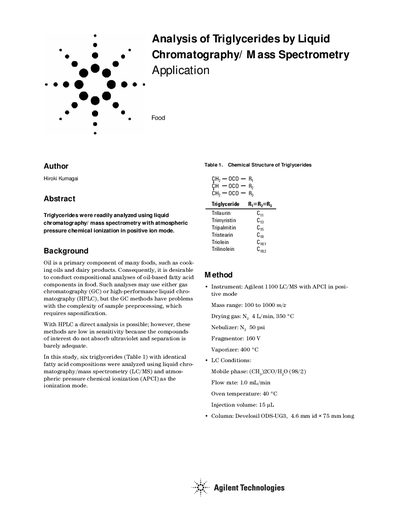
This document details a method for analyzing triglycerides in oil-based food components using Liquid Chromatography/Mass Spectrometry (LC/MS). The study compares this method to Gas Chromatography (GC) and High-Performance Liquid Chromatography (HPLC), highlighting the advantages of LC/MS with Atmospheric Pressure Chemical Ionization (APCI) in positive ion mode regarding sensitivity and sample preparation.
| Instrument | Agilent 1100 LC/MS with APCI in positive mode |
|---|---|
| Mass range | 100 to 1000 m/z |
| Fragmentor | 160 V |
| Vaporizer | 400 C |
| Flow rate | 1.0 mL/min |
| Oven temperature | 40 C |
| Injection volume | 15 uL |
| Column | Develosil ODS-UG3 4.6 mm id x 75 mm long |
SIM mode yielded sensitivity to 1 ppb.
Atmospheric pressure chemical ionization in positive ion mode.