
Triglycerides are the major components in edible oils. This note describes a method for analyzing intact triglycerides by LC/MS and the type of information available.
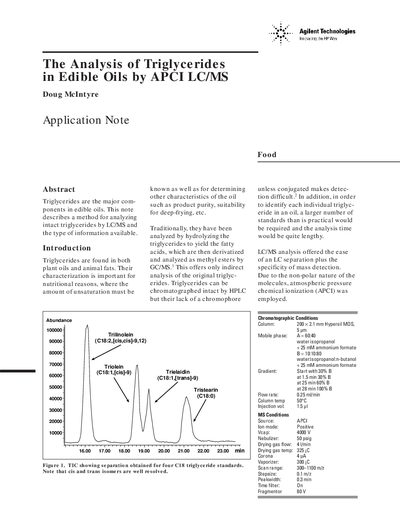
Triglycerides are major components in edible oils and fats. Traditionally analyzed via GC/MS after hydrolysis, they can now be chromatographed intact by HPLC coupled with mass spectrometry (LC/MS). This document details a method using atmospheric pressure chemical ionization (APCI) to detect these non-polar molecules directly.
| Column dimensions | 200 x 2.1 mm |
|---|---|
| Mobile phase A composition | 60:40 water isopropanol + 25 mM ammonium formate |
| Mobile phase B composition | 10:10:80 water-isopropanol:n-butanol + 25 mM ammonium formate |
| Flow rate | 0.25 ml/min |
| Column temperature | 50°C |
| Injection volume | 1.5 ul or 15 ul |
| Ion mode | Positive |
| Veap voltage | 4000 V |
| Nebulizer pressure | 50 psig |
| Drying gas flow | 4 l/min |
| Vaporizer temperature | 300 jC |
Atmospheric pressure chemical ionization (APCI) was employed.
25 mM ammonium formate was added to both mobile phases.
It allows the formation of a more stable [M+18]+ ammonium adduct ion.
The scan range is set from 300-1100 m/z.