
The document describes the features and characteristics of a product, including detailed product specifications and function descriptions.
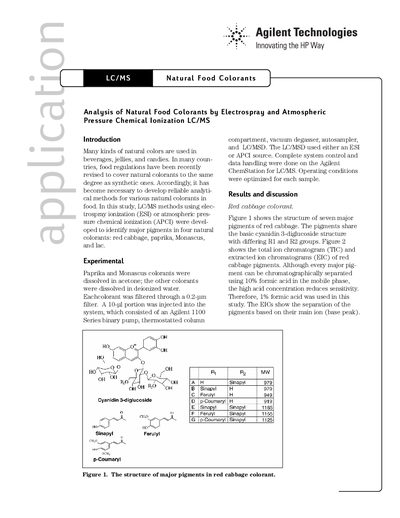
This document details the analysis of natural food colorants found in beverages, jellies, and candies. It focuses on developing reliable analytical methods for red cabbage, paprika, Monascus, and lac colorants using Liquid Chromatography/Mass Spectrometry (LC/MS).
The study utilizes an Agilent 1100 Series binary pump system coupled with an LC/MSD. The document provides specific experimental conditions, including mobile phases, gradient profiles, and MS parameters for both Electrospray Ionization (ESI) and Atmospheric Pressure Chemical Ionization (APCI) sources to identify major pigments in each sample.
| System | Agilent 1100 Series binary pump, thermostatted column compartment, vacuum degasser, autosampler, and LC/MSD |
|---|---|
| Flow rate | 0.2 ml/min |
| Column temp | 40°C |
| Injection vol | 10 ul |
| Vcap voltage | 4000 V |
| Scan range | 100-1200 amu |
The study analyzed four natural colorants: red cabbage, paprika, Monascus, and lac.
A common fragment ion was observed at m/z 567 in the mass spectra of these pigments.