
The document describes the use of liquid chromatography-mass spectrometry (LC-MS) for the analysis of organophosphate pesticides. Compared to existing gas chromatography-mass spectrometry (GC-MS) and ultraviolet (UV) detection methods, LC-MS simplifies sample cleanup procedures, reduces analysis time, and method development time. By using an electrospray ion (ESI) source, this method avoids the thermal degradation of labile pesticides encountered in GC and eliminates the need for preliminary derivatization to increase compound volatility.
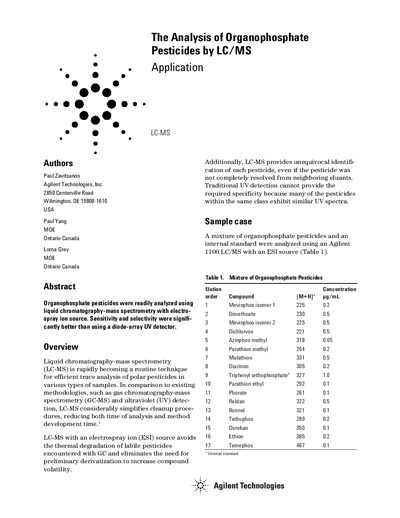
Liquid chromatography-mass spectrometry (LC-MS) is presented as a routine technique for efficient trace analysis of polar pesticides. The method utilizes an electrospray ionization (ESI) source to avoid thermal degradation and eliminate the need for derivatization, providing unequivocal identification even when compounds are not fully resolved.
The document details the analysis of organophosphate pesticides using liquid chromatography-mass spectrometry.
The method uses a column that is 2.1 mm id x 5 cm long filled with 3.5 um particles.
The procedure requires a 3 uL injection volume and a splitless flow of 400 uL/min.