
Analysis of Poisoned Food by Capillary Electrophoresis Application Note

The document introduces a method for detecting toxins using capillary electrophoresis

Analysis of Poisoned Food by Capillary Electrophoresis Application Note - cover page
Brand
Agilent
Document type
Other
Language
English
Pages
2
File format
PDF
File size
53 KB
Published
12 June, 2012
Updated
30 September, 2023
MD5 checksum
95FF1245AAFD74B956F8739964343AB3

About this manual

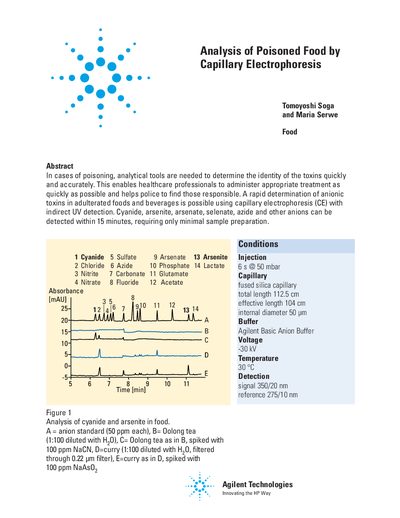
This document describes a method for rapidly determining the identity of anionic toxins, such as cyanide and arsenite, in adulterated foods and beverages. The technique uses capillary electrophoresis (CE) with indirect UV detection to achieve results within 15 minutes with minimal sample preparation.

What's inside

  • Abstract
  • Conditions
  • Experimental
  • Results

Frequently asked questions

How quickly can anionic toxins be detected in food samples?

Cyanide, arsenite, arsenate, selenate, azide and other anions can be detected within 15 minutes.

What is the minimum sample preparation required for this analysis?

The method requires only minimal sample preparation, such as dilution with water or filtration through a 0.22 um filter.

What is the linear range for this assay?

The assay was linear over the range 10-100 ppm with r2 > 0.999.

Download PDF (53 KB)

More Agilent Manuals


View all Agilent manuals →