
The article introduces the HPLC method for analyzing carbohydrates in lemonade.
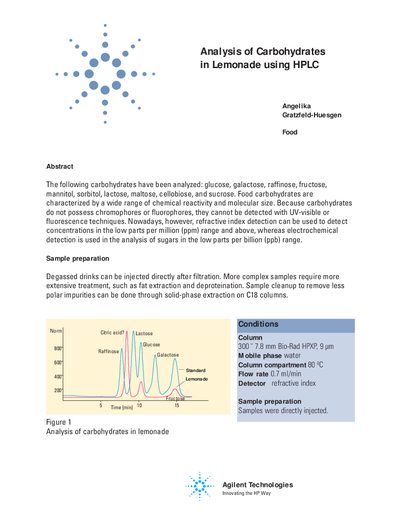
The document details a High-Performance Liquid Chromatography (HPLC) method for analyzing specific mono-, di-, and trisaccharides, as well as sugar alcohols like glucose, fructose, sucrose, and sorbitol. The text explains that because carbohydrates lack chromophores or fluorophores, the method utilizes refractive index detection to measure concentrations in the low parts per million (ppm) range.
The procedure covers sample preparation for degassed drinks, which can be injected directly after filtration, as well as more complex treatments like fat extraction and deproteination. The note specifies the use of an Agilent 1100 Series system equipped with a degasser, isocratic pump, autosampler, thermostatted column compartment, and refractive index detector.
| Limit of detection | <80 ng with S/N = 2 |
|---|---|
| Repeatability of RT over 10 runs | <0.05 % |
The method analyzes glucose, galactose, raffinose, fructose, mannitol, sorbitol, lactose, maltose, cellobiose, and sucrose.
The limit of detection is less than 80 ng when the signal-to-noise ratio equals 2.
The recommended flow rate is 0.7 ml/min.