
This paper introduces a HPLC method based on reversed-phase chromatography and UV-visible diode-array detection for the determination of tetracyclines in meat. The method is simple, sensitive, and suitable for the large-scale determination of samples.
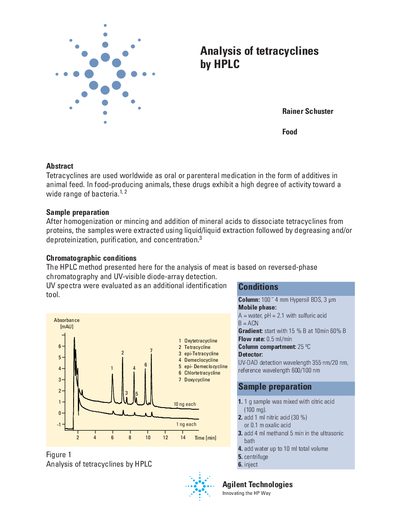
This document presents a High-Performance Liquid Chromatography (HPLC) method for the analysis of tetracyclines in food-producing animals. The method utilizes reversed-phase chromatography with UV-visible diode-array detection to identify and quantify various tetracycline residues.
The procedure covers sample preparation involving homogenization, acid dissociation, liquid/liquid extraction, and purification. It details specific chromatographic conditions, including the use of a Hypersil BDS column, a mobile phase gradient of water and acetonitrile, and detection wavelengths of 355 nm and 600 nm. The note also reports on the method's performance, noting a limit of detection of 100 ppb and high repeatability.
| Column | 100 x 4 mm Hypersil BDS, 3 um |
|---|---|
| Mobile phase A | water, pH = 2.1 with sulfuric acid |
| Mobile phase B | ACN |
| Flow rate | 0.5 ml/min |
| Column compartment temperature | 25 °C |
| Detector | UV-DAD detection wavelength 355 nm/20 nm |
| Reference wavelength | 600/100 nm |
| Limit of detection | 100 ppb |
| Repeatability of RT | <0.2 % |
The limit of detection for UV-DAD is 100 ppb.
The repeatability of retention time (RT) over 10 runs is less than 0.2 %.