
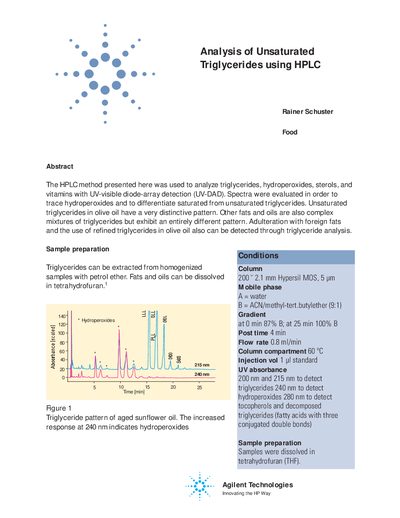
This article introduces a method for analyzing unsaturated triglycerides using HPLC. The method can use UV-visible diode-array detection (UV-DAD) to analyze triglycerides, hydroperoxides, sterols and vitamins. Spectra were evaluated to trace hydroperoxides and to differentiate saturated from unsaturated triglycerides. Unsaturated triglycerides in olive oil have a very distinctive pattern. Other fats and oils are also complex mixtures of triglycerides but exhibit an entirely different pattern. Adulteration with foreign fats and the use of refined triglycerides in olive oil can also be detected through triglyceride analysis.
This document presents an HPLC method utilizing UV-visible diode-array detection to analyze triglycerides, hydroperoxides, sterols, and vitamins. The method is specifically designed to trace hydroperoxides and differentiate saturated from unsaturated triglycerides, with a focus on detecting adulteration in olive oil. Spectra evaluation allows for the identification of distinctive patterns in unsaturated triglycerides found in olive oil compared to other fats and oils.
| Column | 200 ~ 2.1 mm Hypersil MOS, 5 um |
|---|---|
| Mobile phase A | water |
| Mobile phase B | ACN/methyl-tert. butylether (9:1) |
| Flow rate | 0.8 ml/min |
| Column compartment temperature | 60 °C |
| Injection volume | 1 Jl standard |
| Limit of detection for saturated triglycerides | >10 ug |
| Limit of detection for unsaturated triglycerides (1 double bond) | >150 ng |
| Limit of detection for unsaturated triglycerides (2 double bonds) | >25 ng |
| Limit of detection for unsaturated triglycerides (3 double bonds) | <10 ng |
| Repeatability of RT over 10 runs | <0.7 % |
The method uses Agilent 1100 Series equipment including a vacuum degasser, quaternary pump, autosampler, thermostatted column compartment, and diode array detector.
200 nm and 215 nm detect triglycerides, 240 nm detects hydroperoxides, 280 nm detects tocopherols and decomposed triglycerides, and 23.0 nm is used for olive oil analysis.