
A method for the determination of aspartame by high-performance liquid chromatography is described. The method involves low-pH liquid extraction and OPA/MPA derivatization, and exhibits good sensitivity and selectivity.
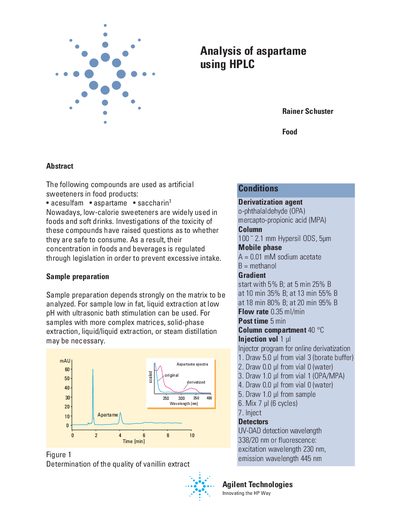
The document details a High-Performance Liquid Chromatography (HPLC) method specifically designed for the analysis of aspartame, an artificial sweetener. The procedure utilizes automated on-column derivatization with o-phthalaldehyde (OPA) and mercapto-propionic acid (MPA), followed by reversed-phase chromatography.
| Limit of detection (fluorescence) | 200 pg (injected amount), S/N = 2 |
|---|---|
| Limit of detection (DAD) | 1 ng (injected amount), S/N = 2 |
| Repeatability of RT over 10 runs | <0.1 % |
The analysis utilizes Agilent ChemStation software.
The limit of detection for fluorescence is 200 pg when the injected amount results in a signal-to-noise ratio of 2.
The limit of detection for DAD is 1 ng when the injected amount results in a signal-to-noise ratio of 2.
The Hypersil ODS column has dimensions of 100 x 2.1 mm and a particle size of 5 µm.