
The HPLC method for direct analysis of glyphosate in water with postcolumn derivatization was presented.
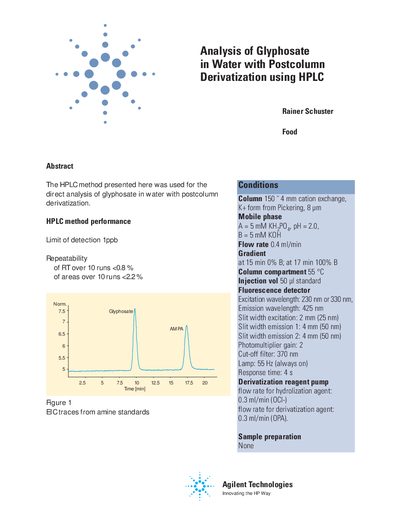
This document presents an HPLC method for the direct analysis of glyphosate in water samples. The method utilizes postcolumn derivatization with OPA and a cation exchange column to achieve high sensitivity.
Key performance metrics include a limit of detection of 1 ppb, with repeatability of retention time over 10 runs being less than 0.8% and area repeatability less than 2.2%. The procedure details specific conditions for the mobile phase, gradient elution, column temperature, and fluorescence detector settings.
| Limit of detection | 1 ppb |
|---|---|
| Repeatability of RT over 10 runs | <0.8 % |
| Repeatability of areas over 10 runs | <2.2% |
The limit of detection is 1ppb.
The flow rate for the hydrolization agent is 0.3 ml/min.
The column compartment is set to 55 °C.