
This article describes the analysis of triglycerides in olive oil and rap oil using HPLC. Unsaturated triglycerides in olive oil have very characteristic patterns. Other fats and oils are also complex mixtures of triglycerides but with different patterns.
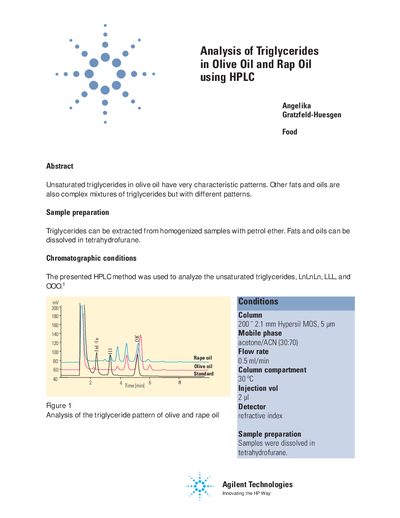
This document details an HPLC method for analyzing unsaturated triglycerides (LnLnLn, LLL, and 000) in olive oil and rape oil. The method utilizes a Hypersil MOS column with an acetone/ACN mobile phase and a refractive index detector.
The application note specifies the equipment required, which includes the Agilent 1100 Series system components (degasser, isocratic pump, autosampler, thermostatted column compartment) and Agilent ChemStation software. Performance metrics such as the limit of detection and repeatability are also provided.
| Column | 200 ~ 2.1 mm Hypersil MOS, 5 um |
|---|---|
| Mobile phase | acetone/ACN (30:70) |
| Flow rate | 0.5 ml/min |
| Detector | refractive index |
| Limit of detection for ECD | 50 pg/l with S/N =2 |
| Repeatability of RT over 10 runs | <0.3% |
The analysis uses an Agilent 1100 Series system including a degasser, isocratic pump, autosampler, thermostatted column compartment, and refractive index detector.
The limit of detection for ECD is 50 pg/l with a signal-to-noise ratio of 2.