
This paper introduces the application of HPLC in the analysis of acidulants in white wine.
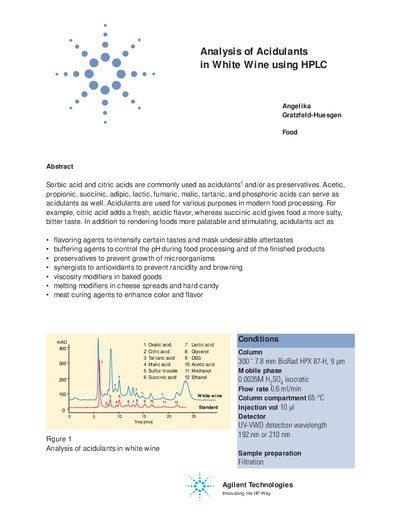
This document details a High-Performance Liquid Chromatography (HPLC) method for analyzing various acidulants, including citric, sorbic, acetic, and lactic acids. It focuses on their use as preservatives and flavoring agents in food processing.
The note provides specific chromatographic conditions using an Agilent 1100 Series system with a BioRad HPX 87-H column. It includes sample preparation steps involving filtration or steam distillation and solid-phase extraction, along with performance metrics such as limits of detection and repeatability.
Sorbic and citric acids are commonly used, while acetic, propionic, succinic, adipic, lactic, fumaric, malic, tartaric, and phosphoric acids can also serve as acidulants.
Acidulants act as flavoring agents, buffering agents, preservatives, synergists to antioxidants, viscosity modifiers, melting modifiers, and meat curing agents.
The limit of detection corresponds to 2 ppm when using an injected amount of 100 ng with a 50 µl volume.