
This document describes the analysis method of bitter compounds in orange juice and lists several common bitter compounds. High-performance liquid chromatography (HPLC) is used for analysis, which is suitable for low volatile or thermally unstable compounds. Sample preparation involves protein precipitation using potassium ferrocyanide and zinc sulfate. The results show the presence of bitter compounds such as hesperidin and naringenin in orange juice.
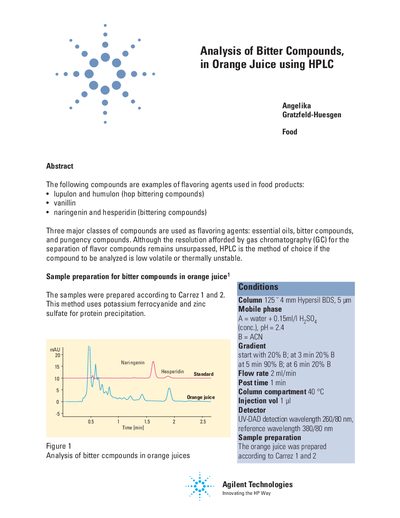
The document presents a High-Performance Liquid Chromatography (HPLC) method developed by Agilent Technologies for the analysis of flavoring agents, specifically bitter compounds such as lupulon, humulon, vanillin, naringenin, and hesperidin. The method is particularly suited for low volatile or thermally unstable compounds where Gas Chromatography might not be optimal.
The procedure details sample preparation using Carrez 1 and 2 reagents (potassium ferrocyanide and zinc sulfate) for protein precipitation in orange juice samples. It specifies the chromatographic conditions, including a Hypersil BDS column, a mobile phase gradient of water with sulfuric acid and acetonitrile, and UV-DAD detection at specific wavelengths.
| Column dimensions | 125 x 4 mm |
|---|---|
| Particle size | 5 ym |
| Mobile phase A composition | water + 0.15ml/l H2SO4 |
| Flow rate | 2 ml/min |
| Column compartment temperature | 40 °C |
| Detection wavelength | 260/80 nm (UV-DAD) |
| Limit of detection | 1 ng |
The method analyzes lupulon, humulon, vanillin, naringenin, and hesperidin.
The samples were prepared according to Carrez 1 and 2, using potassium ferrocyanide and zinc sulfate for protein precipitation.
The system includes an Agilent 1100 Series with vacuum degasser, quaternary pump, autosampler, thermostatted column compartment, diode array detector, and ChemStation software.